
Oil Paint - The Spirit of Matter, Orbach and Galkin, 1997
Medium Characteristics
Oil paint is made of color pigments mixed with linseed oil. The paint comes in tubes in rich shades that blend organically and sensually. It can be diluted with more linseed oil and turpentine and used on fabric, wood, and paper surfaces. The paint can be used in transparent or thick, opaque layers, or applied directly from the tube to create a three-dimensional effect.
Oil paint has a characteristic odor from its diluents, the classic scent of the painter's atelier. Drying time varies with the season and the paint's thickness. When the paint is diluted with turpentine, it dries more quickly than when it is diluted with oil. This medium represents the culture of Western painting and is considered aristocratic.
A variety of tools work well with oil paint: paintbrushes, brushes, spatulas, and even the paint tube itself.
Therapeutic and Spiritual Significance
The encounter with oil paint inevitably brings to our consciousness Western cultural treasures, like paintings by Rembrandt, Leonardo da Vinci, and others. Such associations of exemplary work often discourage the client or art student, causing him to withdraw from the challenge. Because oil paint represents eras of great Western painters, it is a controversial medium for clients and therapists. It brings up themes of cultural elitism, luxury, and, of course, the ability to succeed. Clients are also attracted to or deterred, depending on their sensitivity to the context that the smell and touch evoke. Tactile aspects of the medium precipitate themes of coming close and distancing.

Clients may feel that the therapist is spending a lot of money on them: canvases, quality paints, and special brushes. In other words, issues of economic and cultural value and interpersonal issues arise (the therapist likes me a lot - or not): the selection of the client as unique for the therapist.
Thus, we recommend that a therapist who is not trained in oil painting should not use it in treatment, as the complexity of the technical procedure can create barriers and interfere with the therapeutic process.
Working with oil paint demands the construction of a plan, a long-term process that includes thinking, accumulation of drying layers of paint, and anticipation from one week to the next. Sometimes, it is necessary to imagine what the final product will look like and store it in memory, as repair and change require waiting for the paint to dry. The process will include going back and forth to the canvas repeatedly over several sessions – a process that challenges the ability to delay gratification.

A client who has not developed the ability to work slowly, in cumulative layers, and with planning and patience, is not ready to be exposed to this medium as an expressive matter in the therapeutic encounter.
This old cultural medium is much more than the sum of its parts, and that is also its charm. Because linseed oil is the glue that keeps the pigment together, both chemically and technically, it creates flexibility and endless adjustment. It is an adaptable, varied matter, providing opportunities for change and improvement, thus it is very beneficial therapeutically. In some way, all the colors are like one family. Any placement of color on the surface interacts with the previous color and with the color to follow. Through the alchemy of turpentine and oil, the color moderates and expands. It is a rich and multifaceted alchemical process, accompanied by the artist's memory and the collective memory of all that Western civilization has created. Therefore, working with oil paint creates a resonance between the personal and the collective, and empowers the creator by placing him in an “artistic-family" context.

In addition, this medium symbolizes a well-matched ratio between the surface and what is placed on it and accumulated there. They become one, especially if the layers are constructed slowly and transparently. We can compare the relationship between the surface and the paint to attachment relations, and see that there is a mental-psychological context, a whole alchemy of relationships. The process of working with oil paint encourages emotional development parallel to Ericsson's developmental stages.
On the metaphorical-psychological level, a long working process with oil paint can be a tool for the therapist to help the client rehabilitate his object relations. In the first stage of Ericsson’s theory, questions of trust and mistrust of others arise. A therapist who introduces clients to oil paint gently and trustingly will inspire a sense of self-worth and value, increasing their ability to hope for success.

The second stage reflects autonomy versus shame. The therapist encourages the painter to experiment, creating in a small format or on “experiment pages”, to "have fun" with the oil paint simply and playfully. The client will achieve curiosity, inquisitiveness, interest, a sense of control over the medium, and pleasure.
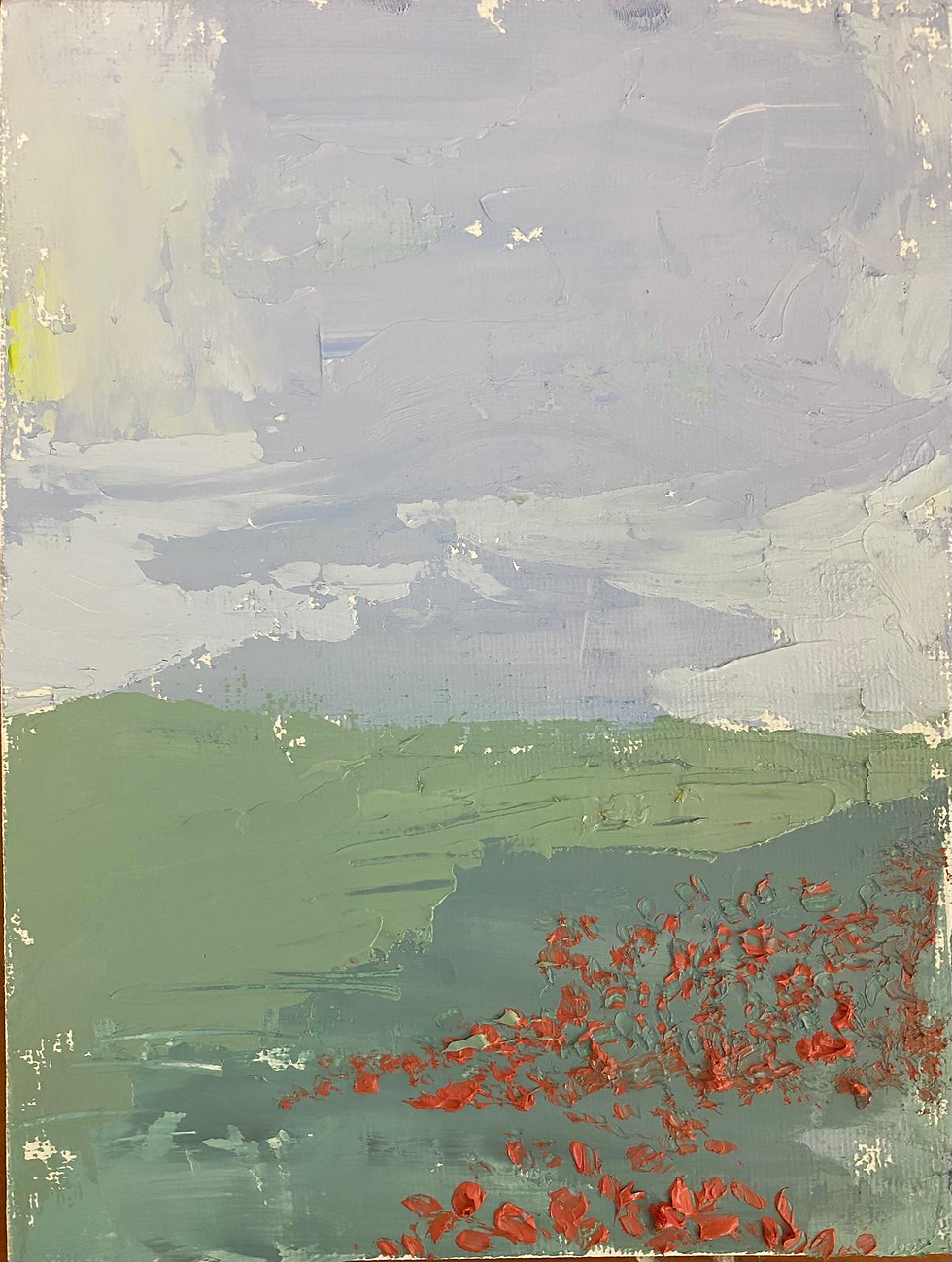
In the third stage, initiative versus guilt, the client is invited to ponder, imagine, and dare to invent an abstract composition or a figurative painting that he wishes to paint. He will gain the ability to set goals and meet them, without guilt or fear of damage and destruction. He may dare to mix things that do not make sense or result in an immediate product, and venture into different color combinations. At this stage, the client is supposed to dare to look a few steps ahead. Industry versus inferiority defines the fourth stage. The client is invited to paint in layers, one on top of the other. Sometimes he might work on two or three paintings simultaneously. He should now agree to be in contact with the matter, trust it, wait, count on the possibility of fixing things in the future, stop from time to time, and see if he likes what he has painted so far. This is a long-term creative process, in which he will gain diligence, motivation, faith, and recognition of his own value.
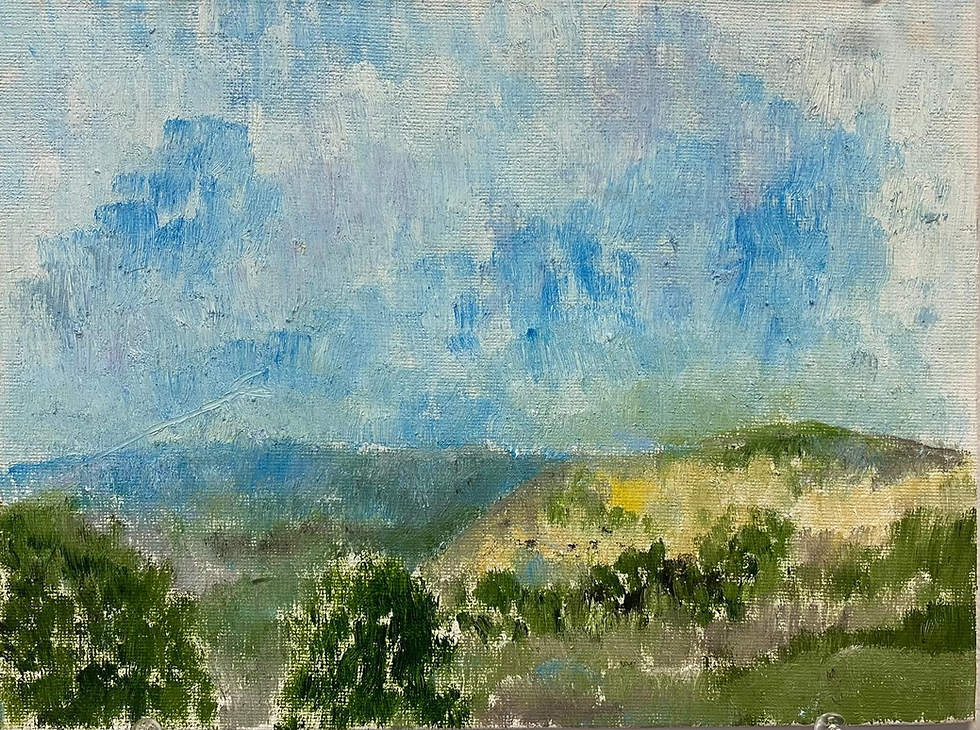
In the fifth stage, ego-identity versus role-confusion, there is experience in various positions without committing to one only, while learning and expanding the painter's self-awareness. Who am I? What are my abilities? What do I want (in my work)?
Continuity in this investigation, with the support of the therapist, will lead to responsibility, loyalty to the work, and to the development of an independent artist's self and identity.
The sixth stage, intimacy versus isolation, encourages the client to become dedicated to oil paint, both the work and the process. He may complete long-term drawings through an independent dialogue with the sketches, as the paint layers and themes emerge from his paintings. He will experience a sense of connection and value because of the significant expressive tool he has developed for himself.

Matter and spirit together become a sublimation. This is an alchemical process between matter, process, history, and resonance in the creator's personality. A client who learns to control oil paint develops technical, emotional, and spiritual regulation, emerging into the world with a sense of competence and belonging in the artistic world. Metaphorically, he has gained a new family.
Surfaces and Tools
Oils work well on canvas and different gesso-covered boards. Brushes should be of good quality and cleaned with care. Linseed oil and turpentine are needed.
Working with Oil Paint
The classic, basic method for working with oil paint is with transparent layers diluted with turpentine. After at least four thin layers, each of which dries slowly, a little linseed oil is added to the diluter, and then the canvas may be covered again with a few additional layers. Painting is then continued with paint diluted with equal amounts of turpentine and oil. Working in layers creates a colorful array of deep, rich hues and shades. One can put a red layer on top of a blue one, or vice versa. The drawing begins with an Indian yellow that creates an inner background light in the painting, beneath the colors added later.
Initial Encounters
Working with two primary colors (red, blue, and yellow) and mixing them. Creating many shades.
Adding white to the two colors.
Adding black to the two colors.
Choosing a specific shade of color and using eight brushes, from the thinnest to the thickest. Experimenting with different brush movements, discovering the brush’s possibilities on the paper. What do different hand movements create? Work on a 35x50 cm. sheet of paper with the widest brush. When the color dries, switch to a smaller brush, then a smaller one still, and so on.
Diluting the color with different amounts of oil and turpentine will create a color range from transparent to opaque.
Painting the same composition on three canvases, in three different ways: the first composition with patches of color, the second with lines, and the third with dots.
Painting the same composition on two canvases, but in two different shades: one in shades of red and the other in shades of blue. Compare the atmosphere, depth, and perspective of the two paintings.
Artwork was created with Noa Shay, artist and art educator. All images are of students who love art and not clients in therapy.
The text is based on The Spirit of Matter / A Database Handbook for Therapists, Artists, and Educators, Nona Orbach and Lilach Galkin, 1997
In the shop, you will find much more in several languages.
Comments